
Here they go again—the war drums on the Potomac are beating so loudly for war against Iran that the CIA stenographers at the NYT have now confidently announced that the next attack will commence this weekend.
And yet and yet. Why?
The overwhelming fact of life in the year 2026 is that Iran is not remotely a military threat to the liberty and security of Americans. Not in Washington DC or Podunk Iowa or anywhere else from sea-to-shinning-sea. Period. Full stop.
Yet real, credible threat of military attack is the one and only reason for a peaceful, constitutional republic to go to war—and most especially to initiate military attacks on the far side of the planet.
That is to say, if you do really believe that America should remain a liberty-based, solvent constitutional republic then you don’t initiate foreign wars just because the target country has bad leaders who oppress their people, or disagreeable religious beliefs and practices, or the wrong allies or even has purportedly acted aggressively against other countries in its regional neighborhood.
These latter excuses, of course, are the sole reasons for what might become the Donald’s next act of military aggression on the world stage. So before it happens yet again, let’s at least be clear that the whole enterprise would be bogus because a valid sine qua non for offensive US military action is utterly, completely and incontrovertibly absent.
Any attack on Iran, therefore, would not be an honest-to-goodness America First endeavor, but just another Empire First exercise in behalf of illegitimate goals: That is, helping an ally we don’t need (i.e. Israel); or enforcing bogus notions of Empire like the so-called “rule of law”; or bringing the blessings of Coca Cola, electronic voting, X-rated movies and long pants to peoples ruled by ostensibly benighted clerics and tyrants.
So we needs hone-in tightly and directly on the one thing that matters—the existence or lack thereof of a presumptive military threat.
The fact is, however, Iran has no military capabilities that are even remotely of the requisite caliber. And that starts with the fact that it has no blue water navy whatsoever. Compared to America’s 5 million displacement tonnage provided by 11 aircraft carriers, 15 Ticonderoga-class guided missile cruisers, 80 Arleigh Burke-class guided-missile destroyers, 70 nuclear powered attack and ballistic missile subs and 50 amphibious assault ships of various types, the Iranian Navy is a nothing-burger, comprised of less than 285,000 tons of displacement or 6% of the US Navy’s firepower.
Moreover, more than three-fourths of its roughly 100 ships are small coastal patrol boats and mini-subs that operate mainly inside the Persian Gulf. Its largest warship, in fact, is a converted oil tanker (the IRIS Makran) that has limited range, no suite of defensive aircraft and missiles and it can carry only a a couple of helicopters and drones.
Likewise, its so-called “drone carrier”, the IRIS Shahid Bagheri, features a small flight deck with a ski-jump ramp at the bow, allowing launch and recovery of up to 60 small, wheeled UAVs (unmanned aerial vehicles). But were this drone carrier to venture outside the Pillars of Hercule (i.e. the Strait of Gibraltar) on any aggressive mission, its rendezvous with Davy Jones’ Locker compliments of US Navy missiles would be swift and certain.
Beyond that, Iran doesn’t have any long-range air or sealift capacity to put a single Iranian soldier on the shores of New Jersey. It also has not a single long-range bomber that can reach New York City or any other US city— with or without a nuclear payload.
Indeed, what passes for the Iranian Air Force is an aging fleet of US F-14s and F-4 Phantoms—plus ancient Soviet MIG-29s. This mainly pre-1979 vintage fleet is older than 55% of the US population and is mainly non-operational and marooned on Iranian airfields owing to lack of maintenance and spare parts.
Likewise, its longest range missiles have an arc of just 2,000 kilometers, which is only half-way to the Strait of Gibraltar, which is 5,000 kilometers away from Tehran; and, even more to the point, only one-fifth of the way to Washington DC, which is 10,000 kilometers away!
Indeed, the reason that Iran’s missiles can’t do any damage to even the hair on the neck of a single American citizen is that the aforementioned 2000 kilometer limit to the range of Iranian missiles is a self-imposed policy limit.
That’s right. Iran’s longest-range operational ballistic missiles are limited by a self-imposed policy cap of approximately 2,000 kilometers (about 1,240 miles), which Iranian officials have stated is sufficient to cover regional threats (e.g., Israel and U.S. bases in the Middle East) but no more.
That is, the one and only route to attacking America open to Tehran is long-range ballistic missiles. Yet the ostensible war-seeking mullahs disarmed their own military!
Moreover, this 2,000 km limit applies to everything they’ve got in their entire missile arsenal. This includes the Sejjil (solid-fuel, two-stage medium range ballistic missile), the Ghadr and variants of the Shahab-3 family (up to 2,000 km in extended versions). Furthermore, the missile most often highlighted as one of Iran’s most advanced in this category—-the Khorramshahr4—has also been designed to conform to the 2,000 km limit.
Nevertheless, during the current so-called negotiations a key Trumpian “red line” has been either elimination entirely or sharp new limits on Iran’s already self-throttled ballistic missiles. But why in they hell is this even on the table and why is the Donald threatening war when Iran’s ballistic missiles are already padlocked with respect to any threat to the American homeland?
We’d guess that the reason is not America First but rather Empire First—- including America’s needless bases and “allies” in the middle east, as we amplify below.
In any event, Iran’s $20 billion defense budget is a pittance which amounts to just 2% of the Pentagon’s $1 trillion annual budget. That is, the entirety of Iran’s military might is equal to about 175 hours per year of US defense spending.
And when it comes to the economic and industrial base necessary to pose a realistic, enduring military threat, fuhgeddaboudit: Iran’s diminutive $400 billion inflation-riddled GDP is heavily dependent upon oil and natural gas exports that can be bottled up in the Persian Gulf with ease. So its industrial base is not a threat to America’s 75 times larger $30 trillion of technologically-advanced and industrially diversified GDP in any way, shape or form.
Moreover, if America were still a constitutional Republic adhering to the founders’ wise admonition to pursue friendly commerce with all nations but entangling alliances with none, the Donald’s current bluster via sending an armada of two aircraft carrier battle groups, much of the US air and sealift capacity, extensive cruise missile and drone fleets, electronics warfare assets and a plenitude of other tools of invasion and occupation to the Persian Gulf region would not have been on the table at all. Nor even under discussion anywhere on the banks of the Potomac.
Indeed, no peaceful republic minding its own business would dream of bombing and invading a nation 10,000 kilometers away–no matter how disagreeable and noxious were its rulers or how hostile its relations with one or more nearby neighbors in the region.
Indeed, war is so inimical to the very health and well being of liberty that the founders counseled against it in no uncertain terms. James Madison himself would have excoriated Donald Trump’s current threat to baldly violate the constitution’s War Powers clause in order to engage in an utterly discretionary act of war unrelated in any way to defense of the American homeland.
The plain truth remains that the War Powers were reserved exclusively for an act of Congress, reflecting the voice of all the people:
“Of all the enemies to public liberty war is, perhaps, the most to be dreaded, because it comprises and develops the germ of every other. War is the parent of armies; from these proceed debts and taxes; and armies, and debts, and taxes are the known instruments for bringing the many under the domination of the few. In war, too, the discretionary power of the Executive is extended; its influence in dealing out offices, honors, and emoluments is multiplied; and all the means of seducing the minds, are added to those of subduing the force, of the people. The same malignant aspect in republicanism may be traced in the inequality of fortunes, and the opportunities of fraud, growing out of a state of war, and in the degeneracy of manners and of morals, engendered by both. No nation could preserve its freedom in the midst of continual warfare.” —James Madison
Indeed, the very idea of launching yet another regime change war on Iran—and those were exactly the Donald’s words recently at Ft. Bragg—is purely a stratagem of Empire.
Asked whether he wanted regime change in Iran, President Trump said it “seems like that would be the best thing that could happen….”
Moreover, in this case “regime change” is not even being disguised as necessary to bring democracy to the long-suffering people of Iran. It’s probably too embarrassing to mention even by Washington’s standards—given that Iran once actually had a functioning democracy until the CIA snuffed it out during the 1953 coup against Mossadegh in behalf of British Petroleum and the British Empire.
Today, of course, Washington’s impending intervention is apparently in behalf of another “ally” that has far, far less to do with America’s homeland security than London did a half century ago on the cusp of the Cold War.
Bibi Netanyahu’s brutal megalomania and outlawry to the contrary notwithstanding, Israel is not America’s “unsinkable aircraft carrier” in the middle east; it’s a rogue belligerent that is an albatross on America’s homeland security, to say nothing of the peace of the planet.
Indeed, the claim that the Trump Administration seeks to “address….the threat that Iran and its proxies posed to United States military bases and close U.S. partners, such as Israel and Saudi Arabia….” is risible in the extreme.
For crying out loud, all those US military bases that surround Iran, as opposed to zero Iranian bases around the US (and barely anywhere else), were not located there before the god which preceded Allah created the Persian nation or even prior to its conversion to the Shiite confession of Islam in the 7th century. Iran is apparently defined as a “threat” by virtue of the fact that it exists inside its own sovereign borders.
As for Iran’s supposed threat to US partners: Iran poses no threat to Saudi Arabia by Riyadh’s own assessment. That’s why the latter embraced a China-brokered reconciliation deal with Iran in March 2023.
And it’s now the reason Saudi Arabia has lobbied against a US strike and refused to allow its airspace to be used for one.
So the sole reason for the Donald’s impending invasion of Iran is to execute by force or blackmail Israel’s demand that it unilaterally disarm by dismantling its ballistic missile program. After all, ballistic missiles that cannot remotely reach the American shores are actually and solely dedicated to functioning as “the last deterrent” in Iran’s arsenal against a renewed attack by Israel. Trump is therefore insisting that Iran abandon its sole means of self-defense from a state that has previously attacked it repeatedly.
At the end of the day, what apparently impends is an intervention on behalf of an “ally” that his done precious little to enhance America’s Homeland Security over the decades, yet which is also the overwhelming reason why the map below appears as it it does.
Even today, there are upwards of 51,000 US troops in the region surrounding Iran but all of them are attributable to the contingencies of Empire and its Israeli branch, not the necessities of Homeland Security. Indeed, the reasons US forces and military assets are now positioned in harms’ way also include the ostensible protection of the Persian Gulf oil supplies and to function as the regional and global gendarme for the alleged good of mankind.
But all of these reasons are just plain illicit.
For example, why in the hell would a peaceful republic even think about stationing 900 US servicemen in the failed state of Syria (before and after the fall of Assad)?
Unfortunately for its polyglot of 17 million Alawites, Druse, Sunnis, Christians, Kurds, Turkmens, Armenians, Yezidis and countless more ethno-fragments Syria has been reduced to a hell-hole of misery by Washington’s 15-year multi-billion interventions in behalf of “regime change”. Yet how in the bloody hell did this tiny $25 billion fragment of a country ever have any bearing whatsoever on the Homeland Security of America?
Surely, by now the same can be said of the 2,000 US military personnel stationed in Iraq, where its own government—one that Washington allegedly liberated from Saddam’s evil clutches—has now pronounced Washington persona non grata.
Likewise, the 10,000 troops stationed in Kuwait is beyond hideous. After all, this “country” actually amounts to little more than a large oilfield surrounded by a few camels, royals and foreign workers. Ditto when it comes to the nearly 15,000 in Qatar and Bahrain, which are hothouse petro-economies generally for sale to the highest bidder.
And most preposterous of all is the 6,500 US sailors aboard US warships in the Mediterranean and the Persian Gulf. Neither of these inland seas have any bearing at all on the defense of the American shorelines or airspace—-to say nothing of nuclear deterrence.
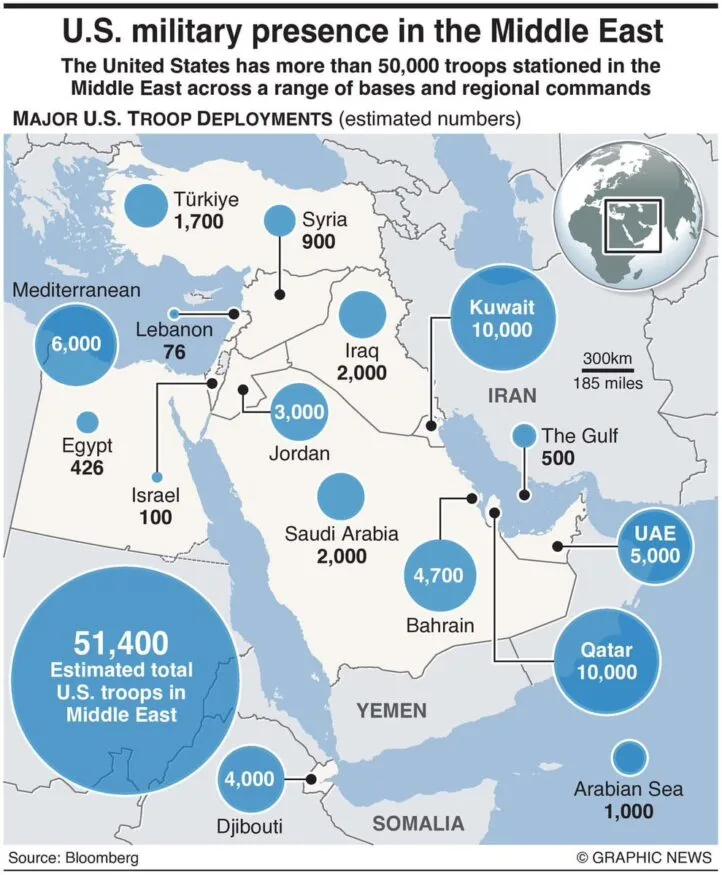
The fact is, a fulsome defense of the American homeland requires none of the bases shown above, nor does it need any allies in the entire region (or elsewhere). That’s because the two requisites of a homeland security are an invincible nuclear deterrent and an ironclad Fortress America defense of the US shorelines and air space.
Neither of these requisites require entangling alliances abroad, foreign military bases or intervention against states like Iran. And it makes no matter whether or not they espouse a noxious theocratic ideology or hold hostile views of their neighbor. Not when they pose no threat whatsoever to the US nuclear deterrent or Fortress America conventional defense.
As it happens, the US nuclear deterrent sports 1,750 active warheads buried deep in 400 Minutemen missile silos, 13 Ohio Class submarines cruising the deep ocean bottoms and 66 strategic bombers. This entire invincible triad deterrent, however, costs just $75 billion per year and requires no foreign bases or operations.
And Iran would be utterly irrelevant to the credibility of the US strategic nuclear deterrent, even if it had nukes, which it does not. Nor has it ever had a plan to get them according to the national intelligence estimates of the US Deep State itself.
Likewise, several hundred billion additional on top of this $75 billion would provide more than an adequate continental air force and attack submarine defense of Fortress America. So in the order of $500 billion plus of the current $1 trillion Pentagon budget is actually for the pursuit of Empire, not direct homeland security, and it is exactly the necessities of Empire which have brought Washington unnecessarily to the brink of war with Iran yet again.
To be sure, one hoary excuse for Empire has long been Persian Gulf oil security. Yet five decades after the early 1970s oil shock one thing is damn obvious: Any regime that gains control of substantial petroleum reserves, whether friendly or hostile to Washington, produces them to the maximum extent because all regimes in the modern world need all the oil export revenues they can muster. As we saw recently, even the head-choppers of ISIS pushed the rickety old oil wells of northeastern Syria to their maximum capacity.
There is no petroleum security need at all, therefore, for the 5th fleet in the Persian Gulf or any of the dozens of land bases in the middle east. At length, any temporary production cutbacks or outages would soon cause the global oil price to rise and worldwide markets to adjust production and conservation levels in the global economy with alacrity.
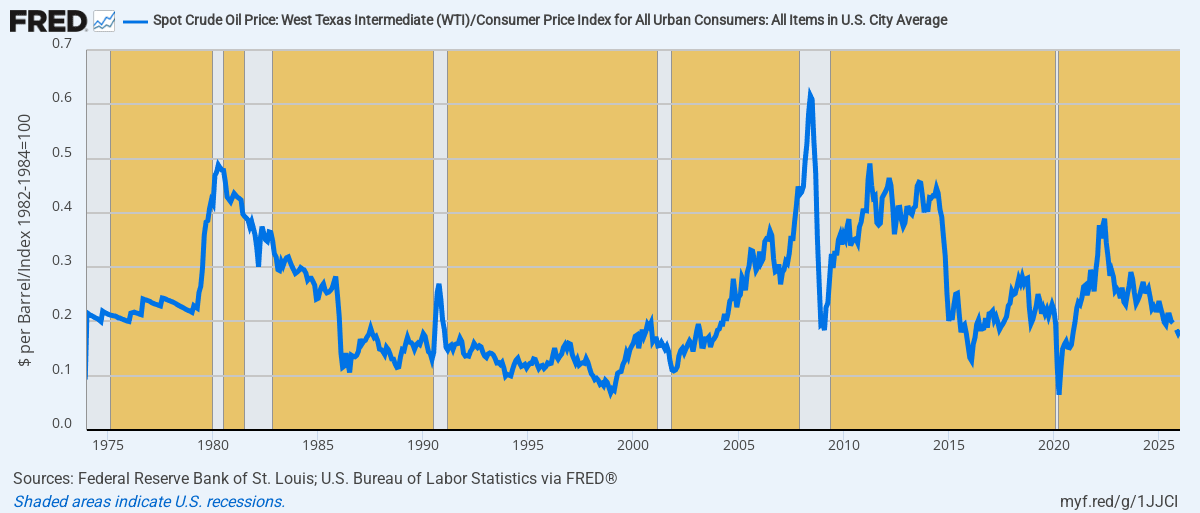
Thus, in the mid-1970s the real post-embargo oil price in 2025 dollars was about $75 per barrel, which is actually slightly above currently prevailing levels, even with the current war premium in the global price. In fact, trillions of US military spending and middle east interventions in the interim have had no effect at all: the global price of oil has oscillated $25 up and $25 down from its current $75 per barrel market-driven equilibrium for the past 50 years.
Index of Constant Dollar Oil Price, 1974 to 2025
Needless to say, the argument that massive Washington military intervention is needed in the middle east to combat terrorism is actually upside down. The limited number of terrorist attacks on the US homeland—including the freakish tragedy of 9/11—were all done by Sunni militants, not Iranian Shiites.
And it is also now pretty clear that the Sunni-based terrorist episodes have been blow-back for massive and multiple US incursions in the middle east that have resulted in a staggering level of death and destruction. According to GROK, the estimated number of Middle Easterners killed in connection with U.S. military interventions there since the First Gulf War ( i.e. over the period 1990 to 2023) is approximately 1.8–2.7 million. This includes direct (combat) and indirect (starvation, disease, displacement) deaths in Iraq, Syria, Yemen, and Libya.
Finally, there remains the issue of why Washington has self-deputized itself to insure that Iran does not get the nuke. And also, in the Trumpian version, not even the right to uranium enrichment, which is guaranteed to all 191 signatories of the Nuclear Nonproliferation Treaty (NPT).
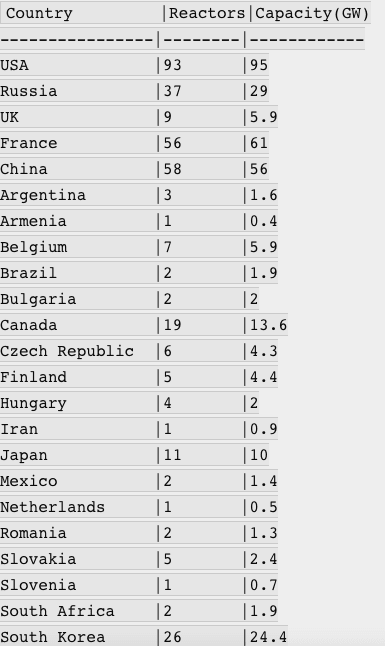
At the present time, 30 NPT signers have active nuclear reactors and a half-dozen of them enrich their own uranium (see the table below).
However, since the Empire Firsters have designated and demonized Iran as a global terrorist state, it alone has been subjected to massive Washington campaigns, including brutal economic sanctions and periodic military attacks like the Donald’s assassination of IRGC leader Qassem Soleimani in January 2020.
Accordingly, as we will amplify in Part 2, the relentless campaign against Iran by Washington is far from a rational response to a nation that actually has a religious edict against nuclear weapons. Iran even agreed in 2015 to a sweeping, intrusive and onerous international control and inspection regime to guarantee that no future government would abandon that principle or depart from its obligations as a signatory to the NPT.
Yet even though the IAEA confirmed they had strictly adhered to the deal, Donald Trump recklessly repudiated it in 2018, owing to the fact that the arrangement was negotiated by Barrack Obama and demanded to be cancelled by Bibi Netanyahu and his neocon confederates at home and abroad.
Reprinted with permission from David Stockman’s Contra Corner.
Subscribe and support here.